
Few things are more frightening than watching your dog suddenly struggle to walk, cry out when picked up, or drag their back legs. In many of these cases, the cause is intervertebral disc disease, or IVDD, one of the most common spinal conditions in dogs.
IVDD can range from mild back pain to complete paralysis, and the difference between a full recovery and permanent damage often comes down to how quickly a dog is diagnosed and treated. Here’s what every owner should know, especially if you have a breed that’s predisposed.
What Is IVDD?
Between each of the bones in your dog’s spine sits an intervertebral disc, a small cushion with a jelly-like center and a fibrous outer ring. These discs absorb shock and allow the spine to flex.
With IVDD, a disc degenerates and either bulges or ruptures, pushing disc material into the spinal canal. That material compresses the spinal cord, causing pain, nerve dysfunction, and in severe cases, paralysis.
Veterinarians generally describe two forms:
- Type I (disc extrusion). The disc’s center hardens prematurely and then ruptures suddenly, often during a normal activity like jumping off the couch. This is the classic form seen in Dachshunds and other short-legged breeds, frequently between ages 3 and 7.
- Type II (disc protrusion). The disc bulges gradually over time, causing slowly worsening signs. This form is more common in older, larger dogs like German Shepherds and Labradors.
Which Breeds Are Most at Risk?
Any dog can develop IVDD, but the risk is dramatically higher in chondrodystrophic breeds, the short-legged, long-backed dogs whose cartilage develops differently:
- Dachshunds (by far the most affected breed)
- French Bulldogs
- Beagles
- Shih Tzus
- Pekingese
- Corgis
- Basset Hounds
- Cocker Spaniels
Larger breeds, including German Shepherds, Labrador Retrievers, and Dobermans, more often develop the gradual Type II form later in life.
Warning Signs of IVDD
Signs depend on where the disc problem is (neck versus back) and how much the spinal cord is compressed. Watch for:
- Back or neck pain. Yelping when touched or picked up, a hunched posture, holding the head low, trembling, or reluctance to move
- Reluctance to jump or use stairs
- A wobbly, drunken gait in the back legs (ataxia)
- Crossing the back legs or knuckling, where the paw flips over and the dog stands on the top of the foot
- Dragging one or both hind legs
- Inability to stand or walk
- Loss of bladder or bowel control
Neck disc problems may show up as front leg lameness, a stiff neck, or crying out when the head turns.
Some of these signs overlap with orthopedic problems, which is one reason a proper workup matters. A dog who is “limping” may actually have a spinal issue. If you’re unsure what you’re seeing, our guide to why your dog might be limping covers how these conditions differ.
The Stages of IVDD
Neurologists commonly grade IVDD by severity, and the grade guides both treatment and prognosis:
- Grade 1: Pain only. Normal walking, but back or neck pain.
- Grade 2: Wobbly but walking. Weakness and incoordination in the legs, still able to walk.
- Grade 3: Unable to walk, but able to move the legs.
- Grade 4: Paralysis with intact deep pain sensation. No voluntary movement, but the dog can still feel a firm toe pinch.
- Grade 5: Paralysis with no deep pain sensation. The most severe stage, and a true surgical emergency. The window for the best outcomes is measured in hours, not days.
A dog can move through these stages quickly, sometimes within a single day. Any progression from pain to weakness, or weakness to inability to walk, warrants immediate veterinary attention.
How IVDD Is Diagnosed
Diagnosis starts with a neurologic examination to localize the problem along the spine and grade its severity. Standard X-rays can suggest disc disease but cannot show the spinal cord itself, so advanced imaging is required to confirm the diagnosis and plan treatment.
MRI is the gold standard for evaluating the spinal cord and identifying exactly which disc is involved. CT is also used in some cases, particularly for surgical planning. Learn more about our diagnostic imaging capabilities and how they help pinpoint spinal disease with precision.
Treatment Options for IVDD
Conservative (Medical) Management
For dogs with pain only or mild weakness, non-surgical treatment is often successful. The cornerstone is strict crate rest for 4 to 6 weeks, which gives the damaged disc time to stabilize. This is combined with:
- Anti-inflammatory and pain medications
- Muscle relaxants when needed
- A gradual, structured return to activity
- Physical rehabilitation to rebuild strength and coordination
Strict rest genuinely means strict: no stairs, no jumping, no walks beyond short leashed bathroom breaks. Dogs often feel better before the disc has stabilized, and too much activity too soon is the most common reason conservative treatment fails.
Surgical Treatment
Surgery is recommended for dogs with significant or worsening neurologic deficits, dogs who don’t improve with medical management, and all dogs who lose deep pain sensation. The most common procedure, a hemilaminectomy, removes a small window of bone over the spinal cord so the surgeon can clear away the herniated disc material and relieve the compression.
Decompressive spinal surgery performed promptly offers the best chance of returning a down dog to walking. Success rates are high for dogs who still have deep pain sensation, and time is the most important factor for those who don’t. Learn more about our Neurosurgery services.
Rehabilitation After IVDD
Whether a dog is treated medically or surgically, rehabilitation plays a major role in recovery. Targeted exercises, underwater treadmill therapy, and balance work help dogs rebuild strength, retrain their gait, and return to comfortable function. Our Rehabilitation and Sports Medicine team works with spinal patients through every phase of recovery.
Can IVDD Be Prevented?
You can’t change genetics, but you can reduce risk and severity:
- Keep your dog lean; excess weight loads the spine
- Use ramps or steps for furniture and cars, especially for at-risk breeds
- Walk with a harness instead of a neck collar
- Discourage repetitive jumping and stair sprinting
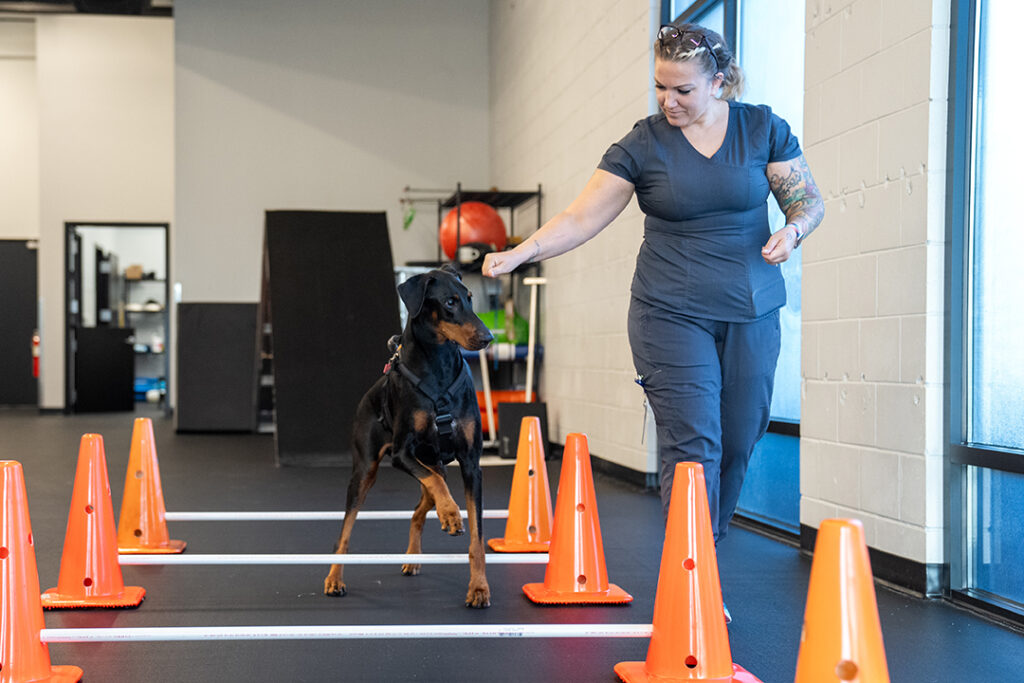
- Maintain core strength with regular, low-impact exercise
When Is IVDD an Emergency?
Seek immediate veterinary care if your dog:
- Suddenly cannot stand or walk
- Is dragging one or both legs
- Loses bladder or bowel control
- Shows rapidly worsening weakness
- Is in severe, unrelenting pain
With spinal cord compression, hours matter. If it’s after hours, go to an emergency hospital first; they can stabilize your dog and coordinate referral for advanced imaging and surgery.
At Kinetic Veterinary Specialists, we evaluate and treat spinal conditions like IVDD with advanced imaging, neurosurgical expertise, and in-house rehabilitation, serving families throughout Clermont, Winter Garden, Orlando, and greater Central Florida, as well as patients who travel to us from farther away.
Frequently Asked Questions
Can a dog recover from IVDD without surgery?
Yes, many dogs with mild IVDD (pain or mild weakness) recover with strict crate rest and medication. Dogs with more severe neurologic signs have much better outcomes with surgery.
How long can you wait for IVDD surgery?
The sooner the better once surgery is indicated. For dogs who have lost deep pain sensation, surgery within 24 to 48 hours offers the best chance of walking again. Rapidly worsening signs should always be treated as an emergency.
Will my dog walk again after IVDD?
Most dogs who undergo surgery while they can still feel their toes return to walking. Even some dogs who have lost deep pain sensation recover with prompt surgery, though the odds are lower. Your surgical team can give a prognosis specific to your dog’s grade.
Is IVDD painful for dogs?
Yes, disc herniation is often very painful, particularly in the early stages. Pain control is a central part of treatment in both medical and surgical cases.
Can IVDD come back after treatment?
Unfortunately, dogs who have had one disc episode are at higher risk of another disc herniating in the future, especially chondrodystrophic breeds. Weight management, ramps, and core strengthening help reduce that risk.