
Hip dysplasia is one of the most common orthopedic conditions in dogs, and one of the most misunderstood. Many owners assume it’s strictly an “old dog” problem, but the condition actually begins in puppyhood, and the earliest signs often show up before a dog’s second birthday.
Whether you have a young large breed dog you’re keeping an eye on or an older dog who’s slowing down, this guide covers what hip dysplasia is, how to recognize it, how it’s diagnosed, and the full range of treatment options available today.
What Is Hip Dysplasia?
The hip is a ball-and-socket joint. In a healthy hip, the head of the femur (the ball) fits snugly into the acetabulum (the socket) and glides smoothly. In a dysplastic hip, the joint develops loosely, so the ball doesn’t sit securely in the socket.
That looseness, called laxity, allows the ball to shift and rub abnormally with every step. Over time, the cartilage wears down, the socket becomes shallow, and bone spurs form. The result is progressive arthritis, pain, and loss of function.
Hip dysplasia is largely genetic, but rapid growth, excess weight during puppyhood, and certain types of exercise can worsen how it develops.
Which Dogs Are Most at Risk?
Large and giant breeds are affected most often, including:
- Labrador Retrievers and Golden Retrievers
- German Shepherds
- Rottweilers
- Great Danes
- Saint Bernards and Newfoundlands
- Bulldogs and other stocky breeds
That said, hip dysplasia can occur in dogs of any size, including small breeds and mixed breeds. Breed simply raises the odds; it doesn’t determine them.
Early Signs of Hip Dysplasia
The signs vary depending on your dog’s age and how far the condition has progressed. Watch for:
- “Bunny hopping” when running, with both back legs moving together
- Difficulty rising from a lying position, especially after rest
- Reluctance to jump, climb stairs, or get into the car
- A swaying or wobbly gait in the hind end
- Reduced activity or exercise tolerance
- Narrow stance in the back legs
- Audible clicking or grating from the hips
- Loss of muscle mass in the thighs, with heavier muscling in the shoulders as the dog shifts weight forward
In young dogs, signs often appear between 4 and 12 months of age. In adults, the picture is usually driven by arthritis: stiffness, slower walks, and pain after activity.
Dogs are good at hiding discomfort, so a subtle change in how your dog moves or behaves is worth taking seriously. If you’re seeing intermittent limping and aren’t sure of the cause, our post on why your dog might be limping walks through the most common possibilities.
How Hip Dysplasia Is Diagnosed
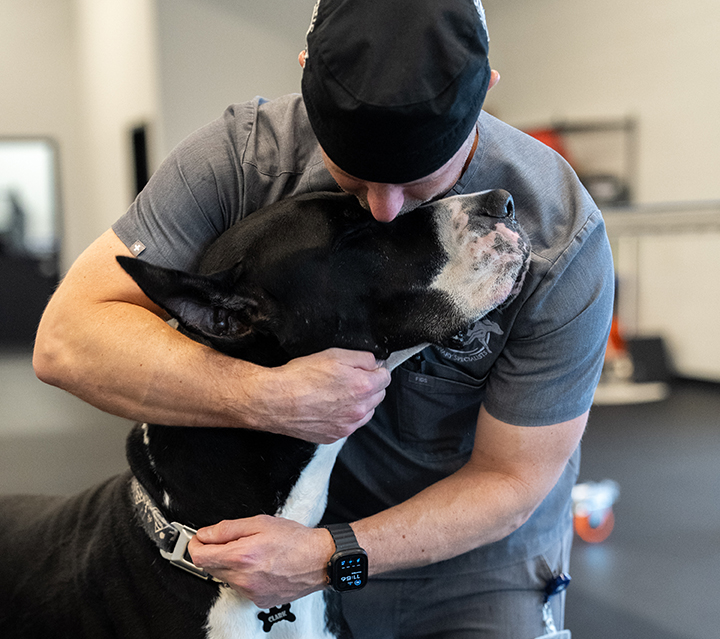
Diagnosis begins with a thorough orthopedic examination. Your veterinarian will watch your dog walk and trot, palpate the hips, and check range of motion and pain response. In young dogs, a specific manipulation called the Ortolani test can detect joint laxity before arthritis develops.
Radiographs (X-rays) confirm the diagnosis and show how much arthritis is present. Because proper positioning requires the dog to be fully relaxed, these are typically taken under sedation. In some cases, additional imaging helps rule out other causes of hind limb pain, such as spinal disease or a cranial cruciate ligament injury, which can look very similar from the outside.
Learn more about how our diagnostic imaging services help pinpoint the source of your dog’s discomfort.
Treatment Options for Hip Dysplasia
Treatment depends on your dog’s age, size, activity level, degree of laxity, and how much arthritis has already set in. The good news: there are effective options at every stage.
Conservative (Non-Surgical) Management
Many dogs with mild to moderate hip dysplasia live comfortable, active lives with a well-designed medical plan. This often includes:
- Weight management. Even a few extra pounds significantly increase the load on painful hips. This is the single most impactful thing most owners can do.
- Physical rehabilitation. Structured exercise, underwater treadmill therapy, and targeted strengthening build the muscle that supports the joint and reduces pain.
- Pain management. Anti-inflammatory medications and other pain relievers prescribed by your veterinarian.
- Joint supplements and diet. Omega-3 fatty acids and joint-support diets can help reduce inflammation.
- Joint injections. Newer therapies delivered directly into the hip joint can reduce inflammation and pain for extended periods. Learn more about our joint injection options.
- Activity modification. Low-impact exercise like swimming and controlled leash walks in place of high-impact running and jumping.
Our Rehabilitation and Sports Medicine team builds individualized plans that combine these approaches to keep dogs moving comfortably.
Surgical Options
When conservative care isn’t enough, or when a young dog is diagnosed early enough to change the course of the disease, surgery may be recommended.
- Juvenile pubic symphysiodesis (JPS). A minimally invasive procedure for very young puppies (typically under 5 months) that guides the pelvis to develop tighter hip sockets. Timing is critical, which is why early screening matters in at-risk breeds.
- Double or triple pelvic osteotomy (DPO/TPO). For young dogs (usually under 10 months) with laxity but minimal arthritis, the pelvis is repositioned to give the ball better coverage in the socket.
- Femoral head ostectomy (FHO). The head of the femur is removed and a “false joint” of scar tissue and muscle forms. This works best in smaller dogs and cats, and in some larger dogs when total hip replacement isn’t an option.
- Total hip replacement (THR). The damaged ball and socket are replaced with prosthetic implants, similar to hip replacement in people. THR offers the most complete restoration of pain-free, normal function and is considered the gold standard for dogs with significant arthritis.
Your surgeon will walk you through which procedure fits your dog’s age, anatomy, and goals. Learn more about our Orthopedic Surgery services.
Can Hip Dysplasia Be Prevented?
Because it’s primarily genetic, hip dysplasia can’t be fully prevented in a predisposed dog. But you can influence how it develops:
- Keep puppies lean during growth and feed a large breed puppy formula that supports steady, not rapid, growth
- Avoid repetitive high-impact activity (long runs, repeated jumping) on developing joints
- Provide traction on slippery floors
- Have at-risk breeds screened early, ideally by 4 months, so time-sensitive options like JPS stay on the table
When to See a Specialist
If your dog is showing signs of hip pain, has been diagnosed with hip dysplasia and isn’t responding to medical management, or is a young large breed dog you’d like screened, an orthopedic consultation is the right next step. Early evaluation opens up more options and better long-term outcomes.
At Kinetic Veterinary Specialists, we diagnose and treat hip dysplasia at every stage, from early screening in puppies to total hip replacement, with advanced imaging, surgical expertise, and in-house rehabilitation all in one place. Families visit us from Clermont, Winter Garden, Orlando, and throughout Central Florida, and we welcome patients traveling from farther away.
Frequently Asked Questions
At what age does hip dysplasia show up in dogs?
Signs can appear as early as 4 to 12 months in affected puppies. Other dogs don’t show obvious symptoms until arthritis develops later in life, often between ages 5 and 10.
Can a dog live a normal life with hip dysplasia?
Yes. With appropriate weight management, rehabilitation, pain control, and in some cases surgery, most dogs with hip dysplasia enjoy long, active, comfortable lives.
Is hip dysplasia painful for dogs?
It can be, particularly once arthritis develops. Because dogs hide pain well, signs like reluctance to move, difficulty rising, and reduced activity are often the way discomfort shows up.
How much does hip dysplasia surgery cost
Cost varies widely depending on the procedure, your dog’s size, and imaging needs. Total hip replacement is the most involved option; FHO and JPS are typically less. Contact our team at (352) 553-2774 for a consultation and personalized estimate.
Does hip dysplasia always require surgery?
No. Many dogs are managed successfully without surgery. Surgery is recommended when medical management no longer controls pain or when early intervention in a young dog can significantly improve long-term joint health.